
Requiring a Vote When Debate Ends
One indication of the Senate’s dysfunction is that it votes less than it used to. Roll-call votes during legislative sessions have declined sharply in recent decades.
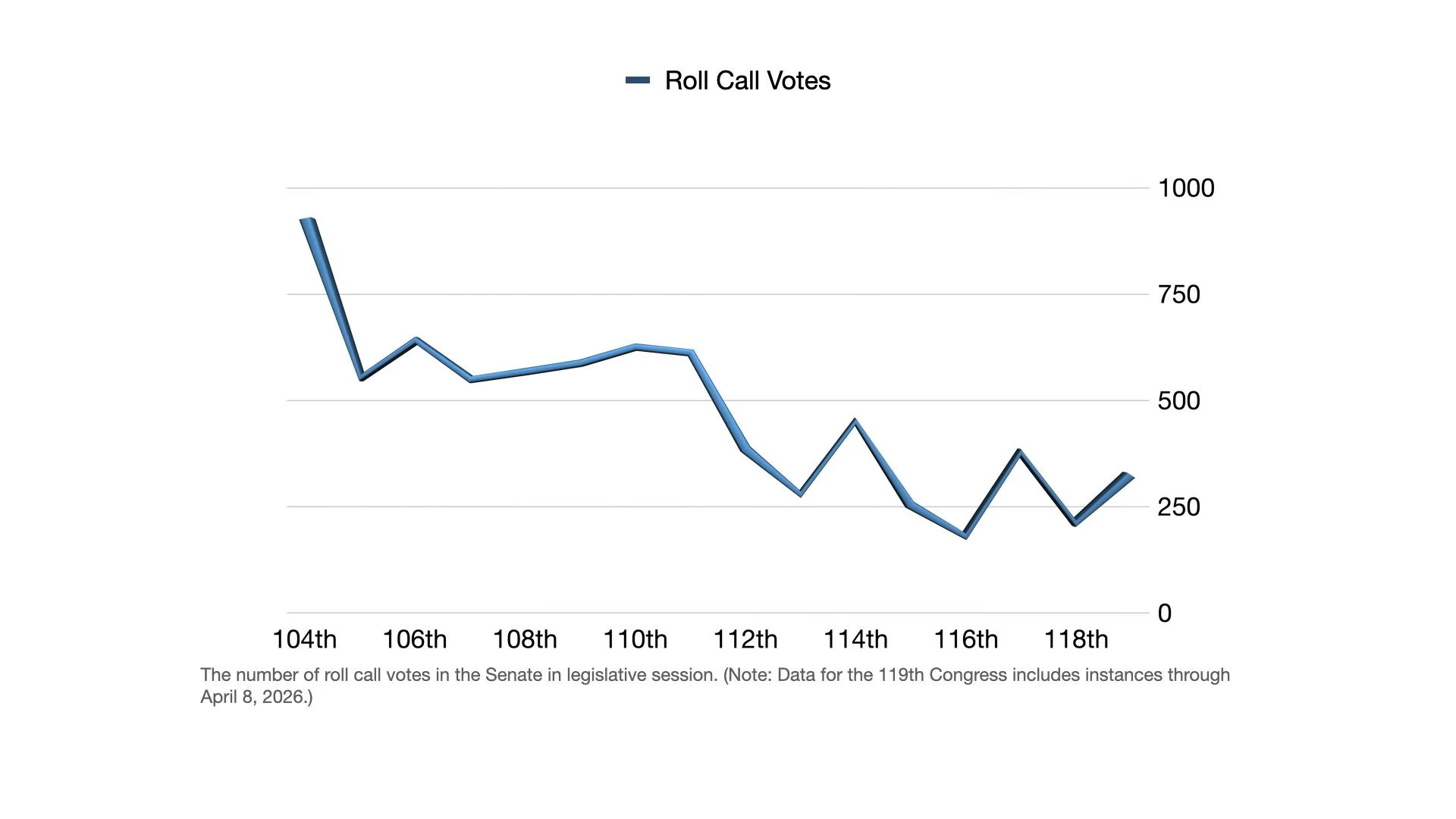
This decline suggests the Senate is deciding less on the floor than in the past. One reason is that senators routinely prevent the presiding officer from putting the pending question to a vote when debate ends by claiming a quorum is absent.
Under Senate precedent, the presiding officer must put the pending question to a vote when a senator yields the floor, and no other senator seeks recognition. But senators routinely prevent that from happening by suggesting the absence of a quorum when they finish speaking. Doing so immediately suspends business and prevents further action until a quorum is established. In practice, however, quorum calls rarely end that way. Instead, another senator asks for unanimous consent to vitiate the quorum call. Until that happens, floor action stops, and the presiding officer cannot put the underlying question to a vote.
The routine use of quorum calls to freeze the floor suggests that the filibuster is not the only reason the Senate is dysfunctional.
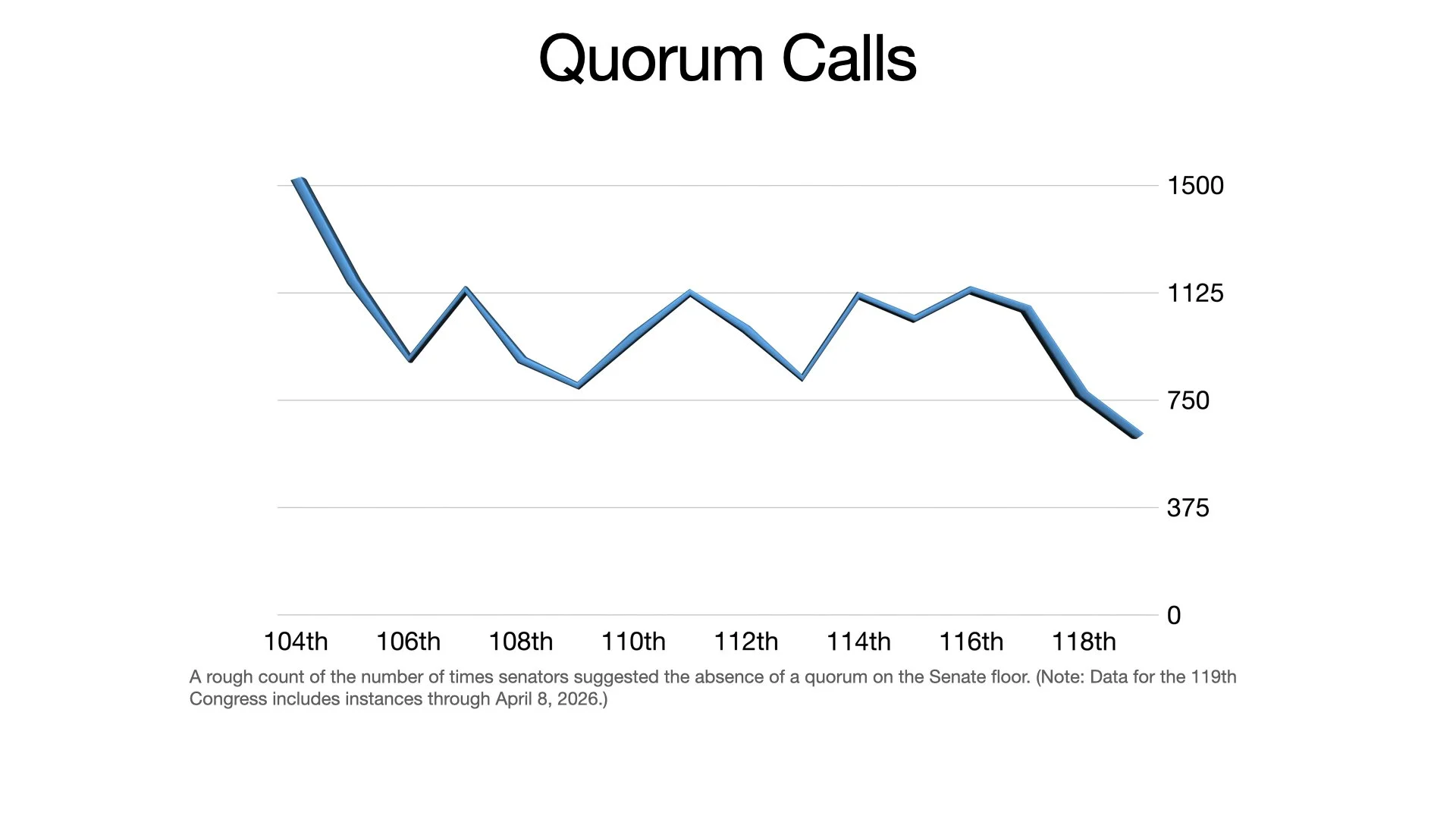
A reform package designed to reduce that dysfunction must therefore address this tactic in addition to making other changes to the Senate’s rules.
How the Senate Decides When to Vote
The Senate has no motion that a majority can use to force an immediate up-or-down vote. Senate precedent is explicit: “It is not in order in the Senate to move a question.” That distinguishes the Senate from the House, where a majority can move the previous question and proceed immediately to a vote. The Senate has no equivalent motion.
Instead, only the presiding officer can put the question. And the presiding officer may do so only in limited circumstances. The presiding officer cannot put the question when a senator is speaking or seeking recognition. Nor can the presiding officer do so when the Senate is in the middle of determining whether a quorum is present.
Outside of those constraints, the Senate gets to a vote in one of three ways.
First, by unanimous consent. For example, the majority leader may ask unanimous consent for a time agreement, providing that the Senate vote at an appointed hour. But that method requires unanimity. Any senator can object and prevent the agreement from being entered.
Second, by Rule XXII’s cloture process. Under this method, the Senate first votes to invoke cloture, then proceeds through a period of post-cloture consideration before finally voting on the underlying question. This method requires a higher vote threshold than a simple majority, does not produce an immediate vote, and instead depends on a multi-step process to set one up.
Third, by statute. Certain laws—such as the 1974 Budget Act and the Congressional Review Act—establish procedures that impose time limits and require votes. But those procedures apply only to specific categories of legislation.
Outside of these three mechanisms, senators can use quorum calls to prevent the Senate from voting.
The Status Quo Rules & Precedents
The Constitution requires that a majority of senators be present for the Senate to conduct business. Article I, section 5, clause 1 provides that “a Majority of each shall constitute a Quorum to do Business” and that a “smaller Number may adjourn from day to day, and may be authorized to compel the Attendance of absent Members.”
Senate Rule VI operationalizes that constitutional requirement. Paragraph 3 states: “If, at any time during the daily sessions of the Senate, a question shall be raised by any Senator as to the presence of a quorum, the Presiding Officer shall forthwith direct the Secretary to call the roll and shall announce the result, and these proceedings shall be without debate.” Paragraph 4 provides that “until a quorum shall be present, no debate nor motion, except to adjourn, or to recess pursuant to a previous order entered by unanimous consent, shall be in order.”
Senate precedent explains how this requirement works in practice. They note that “any senator in attendance can suggest the absence of a quorum, which would stay any action by the Senate until a quorum is ascertained." The Senate can’t "proceed to take any further legislative action until a quorum is established." The precedents are clear - “no debate nor business can be transacted in the absence of a quorum, nor during a quorum call."
The precedents also make clear that the presiding officer currently lacks authority to conduct a unilateral count to determine whether a quorum is present outside the cloture process. In other words, the presiding officer cannot simply look around the chamber and announce that a quorum is present in order to resume business.
Routine quorum calls can also consume significant floor time because there is no effective limit on their duration. Senate precedent states that “no limitation can be set on the length of time of a quorum call.” That is because there is "nothing in the rules which provides for a limit on the time required for quorum calls."
Put these features together, and the problem becomes clear. Any senator may suggest the absence of a quorum. Business stops immediately. The presiding officer cannot independently determine that a quorum is present. No time limit applies. And the quorum call ends only when senators answer the roll—which almost never happens—or when another senator asks unanimous consent that it be vitiated. Until then, the floor is frozen.
How Senators Use Quorum Calls
The primary use of quorum calls today isn’t to verify whether a quorum is actually present or for the minority to obstruct the majority for extended periods. If a quorum is needed, the majority can ordinarily produce one and resume floor consideration.
Instead, quorum calls are used to control the floor.
When senators finish speaking, they routinely suggest that a quorum is absent. That freezes the floor and prevents the presiding officer from putting the pending question. Because unanimous consent is needed to end the quorum call before the roll is completed, nothing further can happen until the Senate agrees to proceed.
In practice, quorum calls are among several procedural devices Senate leaders use to ensure nothing unexpected happens on the floor while they negotiate unanimous consent agreements, line up votes, or decide what to do next behind closed doors.
Both parties do it. Democrats and Republicans alike suggest the absence of a quorum as a matter of routine when they finish speaking.
The consequences of this practice are underappreciated. It shifts decision-making away from the Senate floor—where it is public, less controlled, and more conducive to genuine deliberation—and into closed-door negotiations that are easier to manage but less likely to produce compromise. Senators can take harder positions in private when they are not required to hold the floor, debate in public, or object openly.
Reform Options
A reform designed to reduce Senate dysfunction and facilitate up-or-down votes must address two distinct problems. The first is how to ensure that the presiding officer follows existing precedent and puts the question when debate ends. The second is how to prevent senators from using quorum calls to stop that from happening.
The Senate can’t solve the first problem simply by directing the presiding officer to act a certain way in some informal fashion. Under the Constitution, the vice president is the president of the Senate, and senators do not choose the vice president. Even when a senator is presiding in the vice president’s absence, the Senate can’t assume in advance that the presiding officer will always act as expected.
The solution is to codify the existing precedent in the rules. Doing so would create an enforceable point of order that any senator could raise. It would place the requirement that the presiding officer put the pending question directly in the rules when no senator is speaking or seeking recognition. If the presiding officer declined to do so, any senator could raise a point of order, force a ruling, and, if necessary, appeal that ruling to the full Senate. A majority could then enforce the rule.
But codifying the precedent alone is not enough. Senators would still be able to suggest the absence of a quorum whenever debate paused, thereby preventing the presiding officer from ever reaching the point at which the rule would apply.
The solution to that problem is to limit quorum calls to five minutes when a senator suggests the absence of a quorum and no other senator raises a point of order. After five minutes, the presiding officer would be authorized to determine whether a quorum is present and, if not, to direct the Sergeant at Arms to compel the attendance of absent senators without debate. Once a quorum is established, the Senate would proceed to vote on the pending question.
This approach directly addresses the core problem. It does not require eliminating the Constitution’s quorum requirement. Senators would still be able to suggest the absence of a quorum. The Senate would still need a quorum to conduct business. What changes is the mechanics. After a fixed period, the presiding officer would be empowered to determine whether a quorum is present. And if the chair refused to act, any senator could force the issue by making a point of order and appealing an adverse ruling to the full Senate.
Reform Text
Senators can implement this reform by amending Rule XIX.
Resolution
To amend Senate Rule XIX to require the Presiding Officer to put the question when no senator is speaking or seeking recognition to speak.
Resolved,
Rule XIX of the Standing Rules of the Senate is amended by inserting at the end the following:
"10. The Presiding Officer shall put the pending question if no senator is speaking or seeking recognition to speak. The Presiding Officer shall forthwith direct the Secretary to call the roll if a question shall be raised by any Senator as to the presence of a quorum during debate. If the Secretary has not completed the roll call after five minutes, the Presiding Officer shall determine whether a quorum is present and, if not, shall direct the Sergeant at Arms to compel the attendance of absent Senators, which order shall be determined without debate. Once a quorum is assembled, the Senate shall vote on the question."
The Takeaway
Senate dysfunction will persist so long as senators cannot vote.
This reform would make it easier for the Senate to vote without undermining senators’ individual prerogatives. Specifically, it would prevent senators from routinely using quorum calls to freeze the floor, so that nothing of significance can happen during debate.
Like the other proposals in this series, it would preserve and strengthen floor debate while restoring a path to decision. When no senator seeks recognition, the Senate should vote. That is not a radical principle. It is a necessary condition for the institution to function as a deliberative body at all.