
A Talking Filibuster Doesn’t Guarantee Unlimited Amendments
Republicans don’t have the votes to end Democrats’ SAVE America Act filibuster by invoking cloture on the election overhaul bill. And they have been reluctant to bring it to a final vote by requiring Democrats to speak continuously on the floor while strictly enforcing the Senate’s debate rules, making it harder for them to sustain their filibuster. Republicans have instead opted for an “extended debate” during which Democrats are not required to talk.
One reason Republicans give for their reluctance to force Democrats to mount a true talking filibuster is that doing so allows them to offer “unlimited amendments” to the SAVE America Act. While the Senate can quickly dispose of all amendments without prolonging the filibuster by tabling them, many Republicans worry that the votes to do so could hurt them in November’s midterm elections. Republicans also worry they will not have the votes to defeat amendments on issues such as expired healthcare subsidies.
However, requiring Democrats to speak does not automatically let them offer unlimited amendments. Republicans can rely on Senate rules and precedents to structure debate and limit Democrats’ amendment opportunities.
Limiting Amendments to Bills
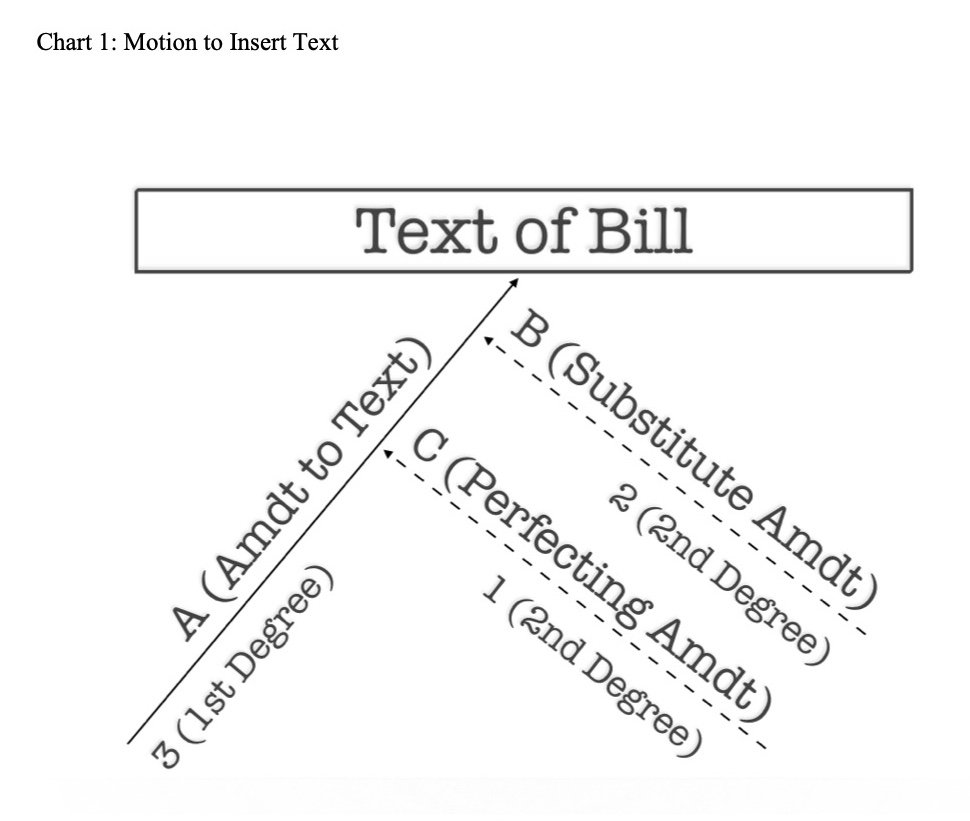
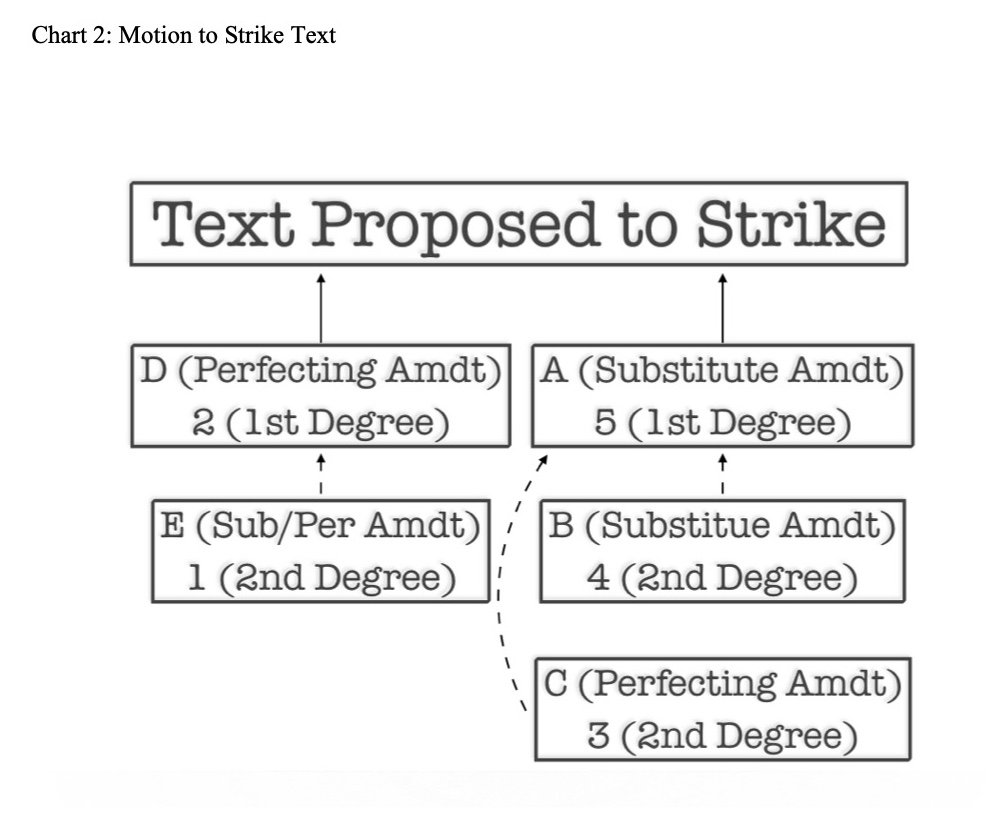
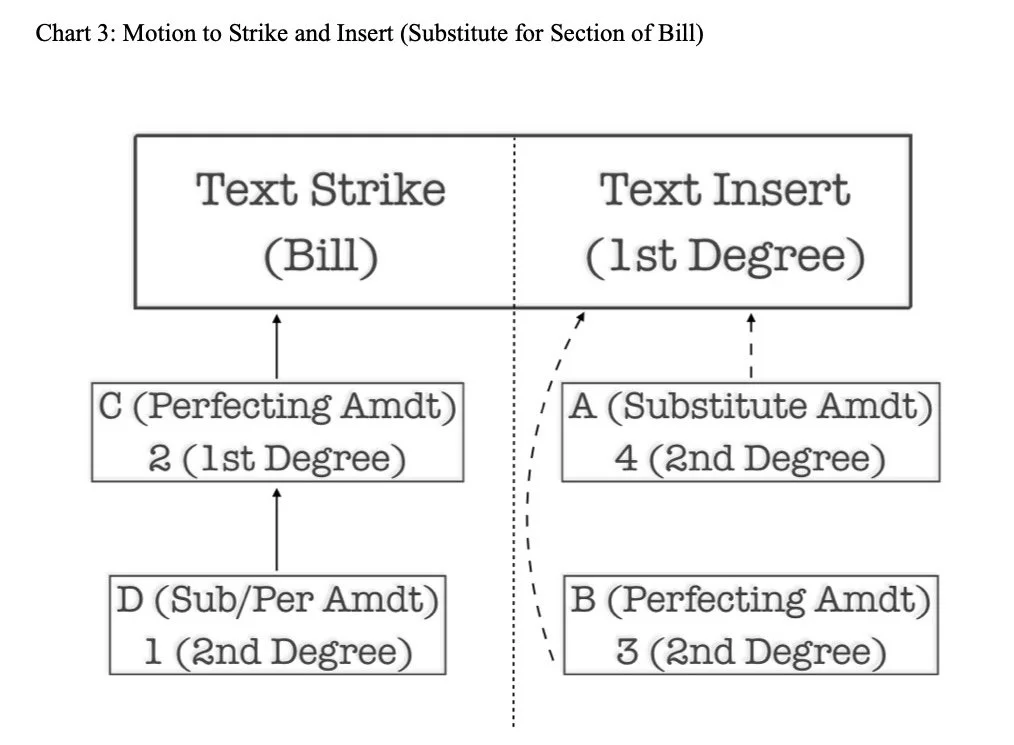
The majority leader usually prevents senators from offering amendments by filling the amendment tree. The amendment tree is a graphical depiction of the total number of amendments that can be pending simultaneously. (Note: Senate precedents refer to the amendment trees as charts.) The Senate uses different trees to depict senators’ amendment opportunities in various situations. Each tree facilitates the orderly consideration of senators’ amendments by adhering to general principles derived from English parliamentary law and first compiled for the Senate by Thomas Jefferson in his A Manual of Parliamentary Practice for the Use of the Senate. According to these principles, the Senate considers committee amendments before floor amendments. They also bar senators from amending legislative text that has already been amended. Given this prohibition, the principles state that senators have an opportunity to amend legislative text proposed to be stricken and/or inserted before the Senate votes on an amendment to strike/insert that text. They give motions to commit precedence over motions to amend. And they stipulate that first- and second-degree amendments are permitted, but third-degree amendments are not.
Applying these principles to the consideration of amendments to legislation within the Senate produces four possible amendment trees. The operative tree in a debate is determined by the first amendment offered. If the first amendment proposes to insert text in the underlying bill, the Senate uses Chart 1.
If the first amendment offered in a debate proposes to strike text in the underlying bill, the Senate uses Chart 2.
The Senate uses Chart 3 if the first amendment offered proposes to strike a section of the underlying bill and insert new text in lieu thereof (i.e., a substitute amendment).
And the Senate uses Chart 4 if the first amendment offered is a full-text substitute for the underlying bill (i.e., an amendment in the nature of a substitute).
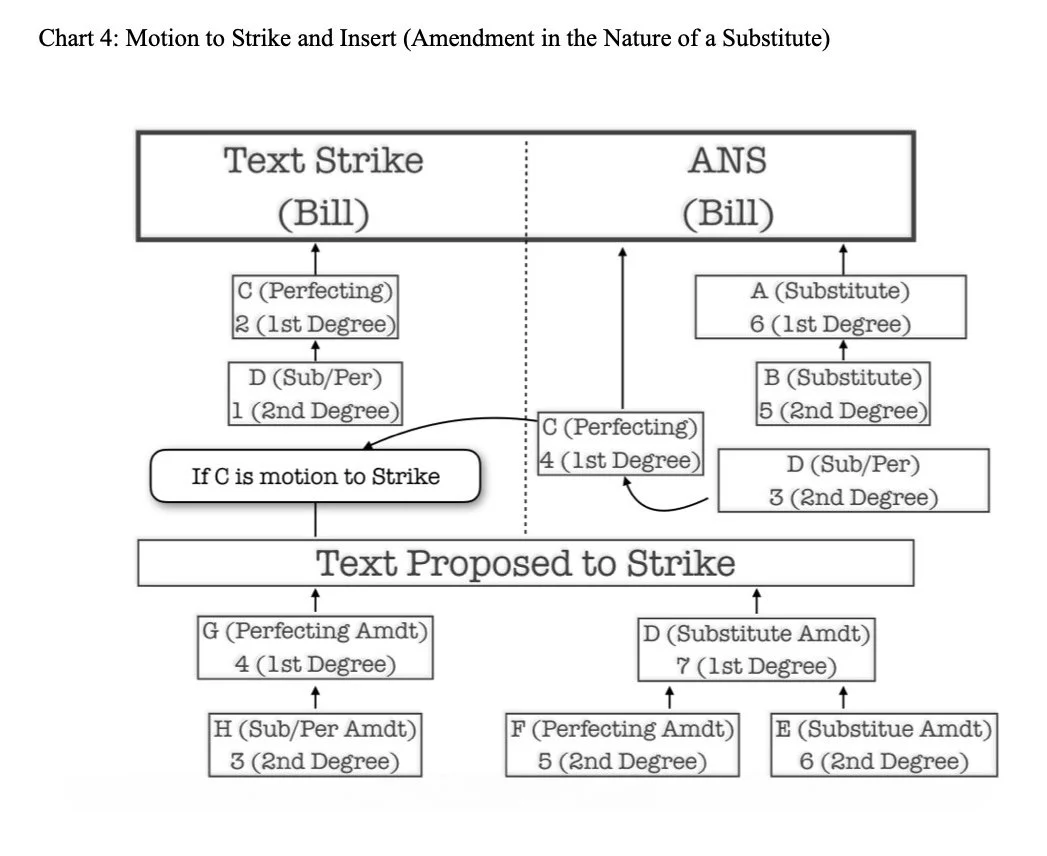
Whatever amendment tree the Senate is using at a particular moment, the majority leader can use his priority of recognition to offer amendments back-to-back before any other senator has an opportunity to offer an amendment. Once the maximum number of amendments is pending and all branches are full, no additional amendments are allowed until the Senate frees up one of the branches by disposing of the amendment pending there.
The Senate must dispose of all pending amendments before the underlying bill receives a final vote (either by an up-or-down vote, a motion to table, or a point of order). Under regular order (i.e., a talking filibuster), a senator can get recognized to offer an amendment when the Senate takes down the amendment tree and before a final vote on the underlying bill. Senators can’t offer amendments when the tree is taken down and before a final vote when the Senate is operating under cloture. This is because Rule XXII allows senators “to speak only” at the end of post-cloture time when the Senate disposes of all pending amendments and proceeds to vote on the underlying bill.
Limiting Amendments to Messages
The general principles above also inform the procedures governing consideration of amendments between the House and the Senate. Senate precedents state that the following motions are in order when a House message is laid before the Senate under Rule VII: “1. To lay on the table; 2. To postpone indefinitely; 3. To postpone to a day certain; 4. To refer; 5. To amend; 6. To agree; 7. To disagree.” (The motions take precedence in the order listed.)
The process by which the Senate considers amendments to a House message differs from the amendment process for amendments to bills within the Senate. For example, when considering amendments to bills in the Senate, the Senate must vote on the underlying bill as amended after approving an amendment. When considering a House message, however, the Senate does not vote on the House amendment as amended after it approves a motion to concur in the House amendment with a Senate amendment. Senate precedents state, “A motion to concur in a House amendment with an amendment if adopted is the final action and does not allow further amendments to be called up to that House amendment.”
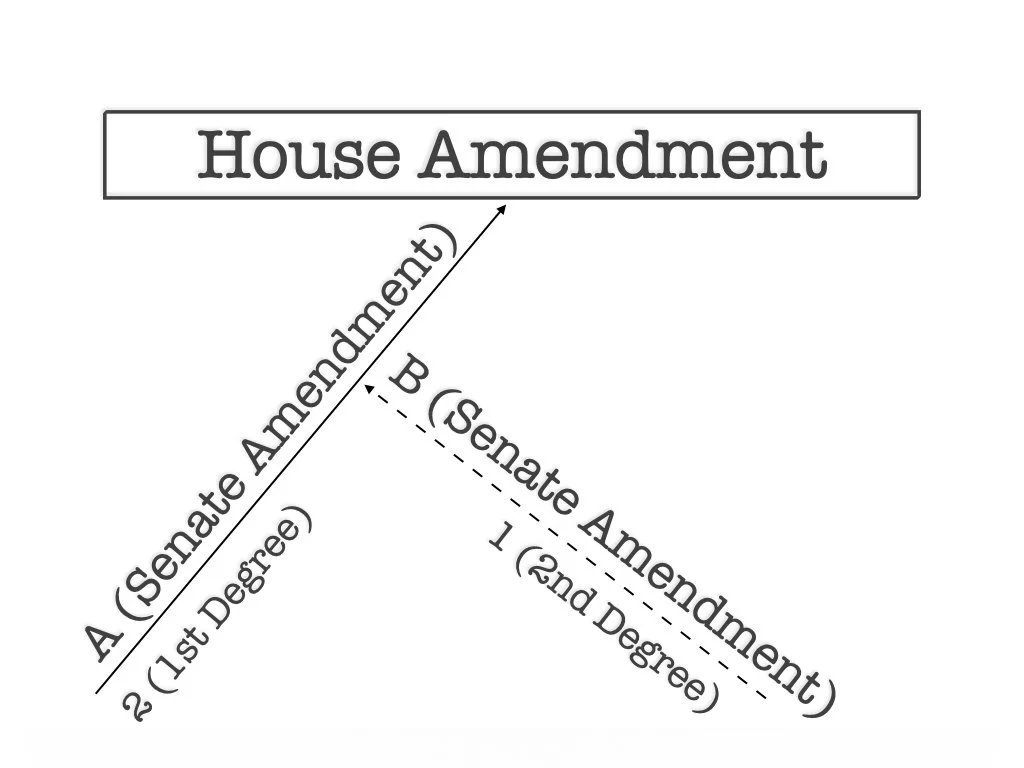
The Senate also uses a different amendment tree when considering amendments to a House message. Its precedents state, “when acting on an amendment of the House, that amendment is open to amendment in two degrees; that is, an amendment to the House amendment, and an amendment to the amendment to the House amendment.”
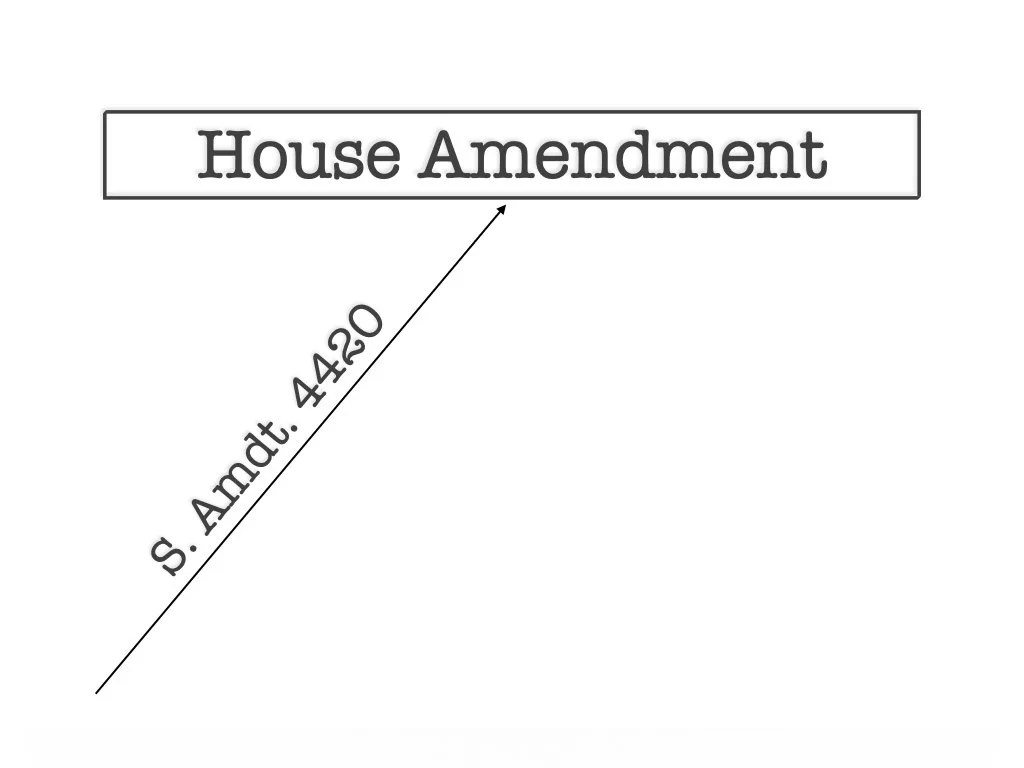
During the debate on the SAVE America Act, Thune moved to concur in the House amendment to S. 1383 with a Senate amendment (S. Amdt. 4420).
Thune next used his priority of recognition to offer S. Amdt. 4421 to S. Amdt. 4420, thereby blocking senators from offering further amendments.
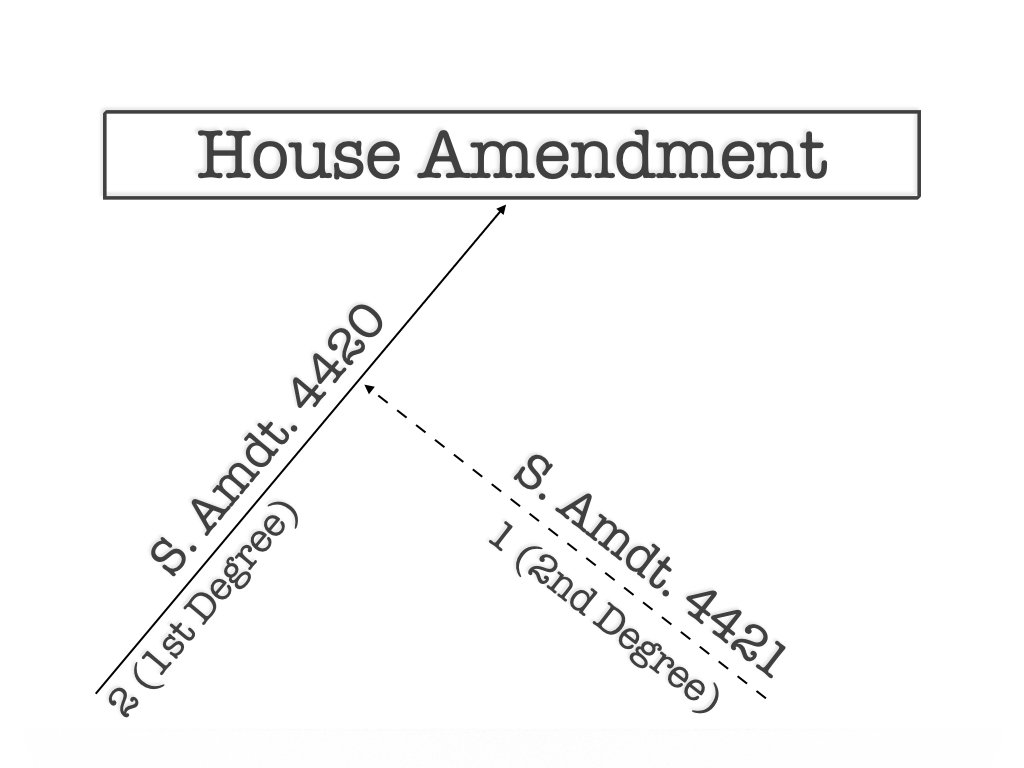
Once S. Amdt. 4421 is pending, Democrats can only attempt to amend the House message by referring it to a committee with instructions to report back forthwith after making specific changes. To prevent this, Thune used his priority of recognition to move to refer the House message to the Rules and Administration Committee, with instructions to report back forthwith (S. Amdt. 4422). He then used his priority to fill the branches on the tree created by his motion with instructions. He offered an amendment (S. Amdt. 4423) to the instructions, and then another amendment (S. Amdt. 4424) to that one.
Structuring the amendment process differently would have allowed Republicans to limit Democrats’ ability to offer amendments before a final vote on the motion to concur in the House amendment to S. 1383 with an amendment (i.e., the SAVE America Act). Specifically, Republicans could have used the prohibition on amending legislative text twice and third-degree amendments to block additional amendments. This is because no amendment is in order after the Senate approves the second-degree amendment to the motion to concur in the House amendment with a Senate amendment. Senate precedents state, “a substitute as amended by another substitute would not be open to further amendment.”
After two full-text substitutes are pending, Republicans could enforce Rule XIX’s two-speech cap on filibustering senators to reach a final vote. Democrats could still move to refer the House message to a committee with instructions. But Senate rules limit what those instructions can require. Rule XV, paragraph 5 says, “It shall not be in order to consider any proposed committee amendment…which contains any significant matter not within the jurisdiction of the committee proposing such amendment.” Rule XXV gives the Rules and Administration Committee jurisdiction over the House message on the SAVE America Act. Thus, motions to refer the House message to the Rules Committee with instructions adding language not in its jurisdiction are not in order. Democrats are therefore limited to offering amendments within the Rules Committee's jurisdiction. All other amendments could be disposed of by a point of order.
The Senate has, in the past, referred legislation to committees with jurisdiction over some of its provisions. But its rules and precedents do not explicitly allow a senator to move to refer the House message to a committee that doesn’t have jurisdiction over its provisions, with instructions to make changes within that panel’s jurisdiction.
Instead, Senate Rule XVII governs the initial referral of legislation. It states when “a controversy arises as to the jurisdiction of any committee with respect to proposed legislation, the question of jurisdiction shall be decided by the presiding officer, without debate, in favor of the committee which has jurisdiction over the subject matter which predominates in such proposed legislation.” In the past, the presiding officer has advised that instructions included in a motion to refer must relate to the underlying proposal to be referred. Precedent also suggests that a motion to refer a conference report to a committee without jurisdiction over its provisions can only instruct the panel to study it or hold hearings. In such situations, the instructions can’t direct the committee to report the conference report back to the Senate with changes.
In 2024, the Senate rejected a motion offered by Marsha Blackburn to refer the House amendment to the Senate amendment to the House-passed Consolidated Appropriations Act of 2024 (S. 2882) to the Judiciary Committee, with instructions to report back the bill with an amendment consisting of the “Laken Riley Act” (a measure unrelated to the underlying House amendment). The Judiciary Committee had jurisdiction over the instructions but not the underlying House message to be referred.
But Senate action on the Blackburn motion to refer with instructions does not constitute precedent in and of itself. This is because it was made pending and received a vote by unanimous consent. Senate precedents clarify the relationship between unanimous consent agreements and the Senate’s rules. The precedents state, “a unanimous consent agreement changes all Senate rules and precedents that are contrary to the terms of the agreement, and creates a situation on the Senate floor very different from that which exists in the absence of such agreement…unanimous consent agreements are designed to suit each individual situation.”
If Senate precedent bars senators from moving to refer a House message to a committee lacking jurisdiction over its provisions and instructing it to report it back with changes unrelated to those provisions, Republicans can use them to prevent Democrats from using a motion to refer with instructions to force votes on amendments outside of the Rules and Administration Committee’s jurisdiction. If Senate precedent is silent on this question, it remains unadjudicated. In which case, Republicans could clarify the precedent.
The Takeaway
Republicans have more tools at their disposal to break a talking filibuster and limit amendments than they've chosen to use. They can enforce Rule XIX’s two-speech cap on filibustering senators to prevent unlimited debate. And they can use the Senate’s rules and precedents to prevent unlimited amendments and limit motions to refer with instructions to amendments within the Rules and Administration Committee's jurisdiction. If the precedents are silent on that last point, Republicans could easily clarify the situation by forcing the issue without using the nuclear option to bypass the rules entirely. The talking filibuster path isn't without friction, but the "unlimited amendments" concern Republicans keep citing as their reason for avoiding it is more manageable than they suggest. Republicans have procedural options they haven't exercised. The rules aren’t preventing a final vote on the SAVE America Act. The unwillingness of Republicans to use the rules is.