
Limiting Debate on the Motion to Proceed
The Senate can reduce dysfunction by adopting four reforms to its Standing Rules: limiting debate on the motion to proceed, prohibiting the majority leader from filling the amendment tree, authorizing a previous question motion, and requiring votes when debate ends. These reforms would make the Senate more efficient, ensure greater participation, and allow for more inclusive decision-making. This article focuses on the first proposal, presenting data on senators’ frustrations with the current approach, reviewing the rules governing debate on the motion to proceed, examining the Senate’s past handling of the issue, and outlining reform options before proposing rule text.
The Data
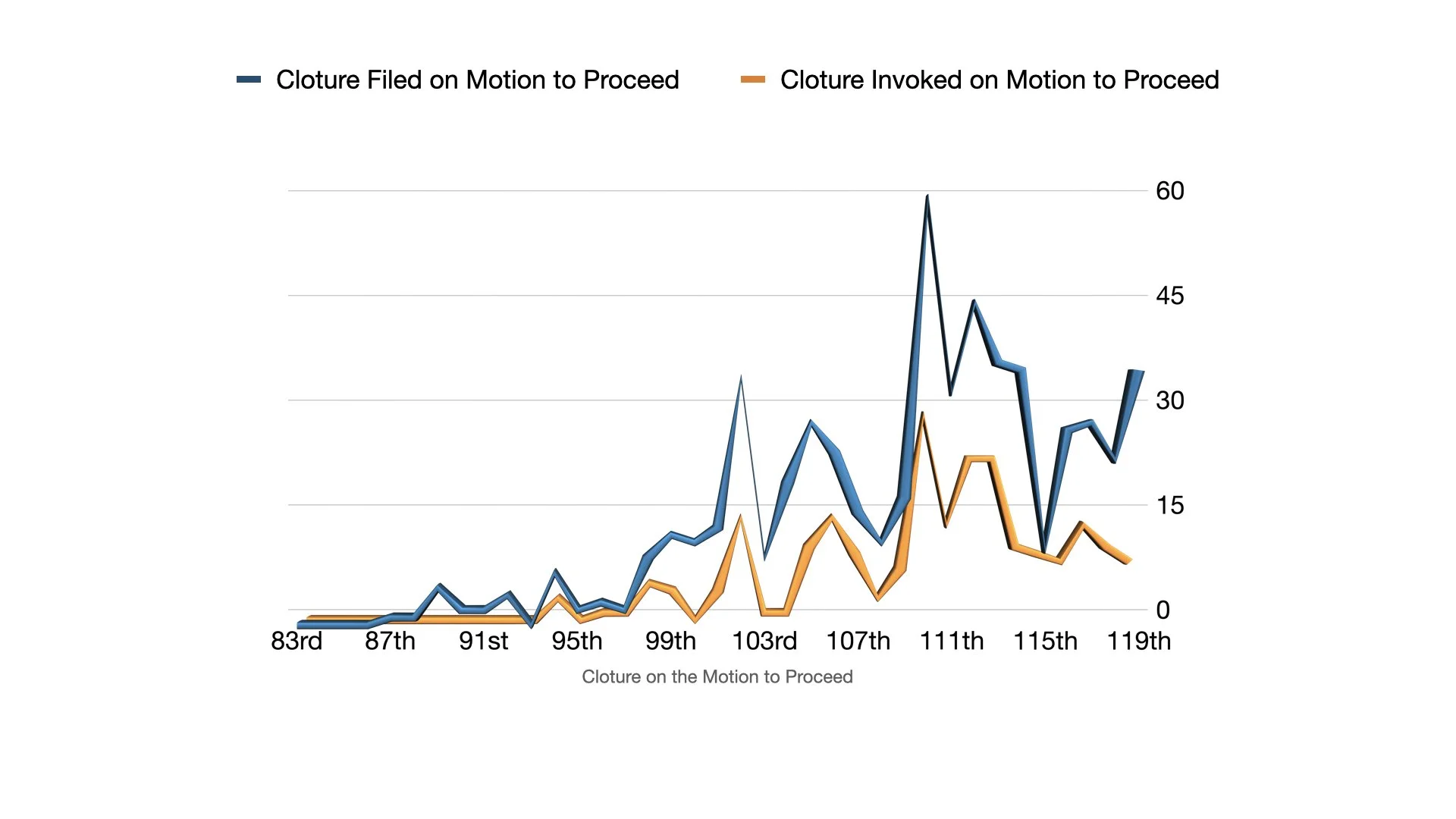
Democratic and Republican majorities alike have been frustrated with the Senate’s inability to begin floor debate on legislation. The majority typically files cloture on the motion to proceed to a bill when the Senate can’t begin debate by unanimous consent. The chart below shows the number of cloture filings on the motion to proceed in each Congress.
The Status Quo
Under the Senate’s rules, most motions to proceed to legislation are debatable. Rule VIII states that “motions made after the first two hours of a new legislative day to proceed to the consideration of bills and resolutions are debatable.”
But not all motions to proceed are debatable. For example, Rule VIII stipulates that a motion to proceed is nondebatable if made during the first two hours of a new legislative day. Rule VII states that a motion to proceed to “any bill or other matter sent to the Senate by the President or the House… shall be determined without debate.” Rule XXVIII stipulates that a motion to proceed to a conference report is “immediately put, and shall be determined without debate.” The Congressional Budget Act of 1974 also makes motions to proceed to budget resolutions and reconciliation bills nondebatable. And Senate precedents stipulate that a motion to proceed in executive session to consider something on the executive calendar is not debatable. The same applies to a motion made in executive session to proceed to legislative session.
The Senate has several ways to end debate on a motion to proceed. The first is attrition. In this approach, the Senate doesn’t end debate so much as wait for it to end. That is, until every senator who wants to speak on the motion to proceed has done so. When no senator seeks recognition, Senate precedents require the presiding officer to call a vote on the motion to proceed.
The second way to end debate on a motion to proceed is by unanimous consent. This approach requires every senator to agree, or at least that no senator present objects, when the request is made.
The third way to end debate on a motion to proceed is by enforcing Rule XIX’s two-speech cap on filibustering senators. The rule allows senators to give two speeches on the same question on the same legislative day if the presiding officer or another senator enforces it.
The fourth way to end debate is by invoking cloture on the motion to proceed under Rule XXII. Under the rule, the Senate may end debate on a motion to proceed to legislation by an affirmative vote of “three-fifths of the senators duly chosen and sworn” (typically 60 senators). The threshold is higher – “two-thirds of the senators present and voting” (typically 67 senators) -when the motion to proceed concerns a measure or motion to amend the Senate rules.
The History
The Senate adopted nondebatable or limited-debate motions to proceed at various points in its history. In 1868, the rules made a motion to proceed to executive business nondebatable. The rules also barred senators from debating a bill’s merits during a motion to proceed. They could only discuss whether the Senate should agree to debate it.
The Senate adopted a limited-debate motion to proceed in 1881. The rule allowed fifteen minutes of debate on a motion to proceed. And it permitted each senator to speak for no more than five minutes. However, the rule applied only to that session. Adopted on February 12, 1881, it expired on March 3 at the end of the 46th Congress, nineteen days later.
In 1884, the Senate again changed its rules regarding the motion to proceed. First, it amended Rule VII to make motions to proceed to the consideration of messages sent by the President and the House nondebatable. Then, it amended Rule VIII to make a motion to proceed before 2 p.m. nondebatable.
When the Senate adopted Rule XXII in 1917, creating a cloture process, the rule did not apply to motions to proceed to legislation. This issue came to a head in 1948, when senators tried to file cloture on a motion to proceed to an anti-poll tax bill. Richard Russell, D-Ga., raised a point of order, arguing that a motion to proceed was not itself a “pending measure” under Rule XXII but only a motion to make a measure pending. The presiding officer agreed with Russell and sustained his point of order.
The Senate reversed course the following year. In 1949, senators applied Rule XXII to motions to proceed to the consideration of legislation and to all other matters pending before the Senate.
Finally, the motion to proceed was at the center of a 1975 fight over Senate rules reform. That year, a majority used what later came to be called the nuclear option to establish majority cloture on a motion to proceed to a resolution that would have changed the Senate rules at the beginning of a new Congress. Senators opposed to the move eventually forced the Senate to reverse that precedent after fifty days of continuous debate.
Since 1975, senators from both parties have proposed limits on debate on the motion to proceed. In recent years, Democrats proposed debate limits on the motion to proceed in 2011 and 2013. And Republicans proposed making the motion to proceed to appropriations bills nondebatable in 2015.
The problem is not new. Senators in both parties have acknowledged that existing rules for the motion to proceed can make it harder for the Senate to consider legislation.
Reform Options
Past proposals to make motions to proceed nondebatable have sought to limit rather than eliminate debate. Senators have generally taken one of two approaches. Some have proposed amending Rule VIII. (For example, see S. Res. 662 in the 111th Congress, and S. Res. 10 and S. Res. 12 in the 112th Congress.) Others have proposed amending Rule XXII. (For example, see S. Res. 4, S. Res. 16, and S. Res. 600 in the 113th Congress, S. Res. 20 and S. Res. 122 in the 114th Congress, and S. Res. 728 in the 115th Congress.)
Amending Rule VIII is simpler. It would directly amend the rule on whether motions to proceed are debatable, but still preserve those currently nondebatable under Senate rules, statutes, or precedents. In contrast, amending Rule XXII would leave Rule VIII’s fully debatable motion to proceed intact and try to solve the problem indirectly through the cloture rule. Senators could achieve a similar outcome by creating a limited-debate motion to proceed for particular bills (e.g., appropriations bills). But this would have unintended consequences by altering the balance of power between Senate committees and senators. It would also make the Senate rules unnecessarily complex.
Amending Rule VIII could make it harder for the majority leader to use procedural tactics to prevent floor votes. In practice, the majority leader can delay other senators from forcing votes by filing cloture on one bill and then offering a debatable motion to proceed to another bill, thus occupying floor time until the cloture motion ripens and the Senate votes. Amending the rule to allow only limited debate on such motions would shorten the time these blocking motions could be pending, making the tactic less useful and increasing the likelihood that senators could force votes by moving to proceed to a bill and filing cloture. While the majority leader could still offer a series of limited-debate motions and withdraw them before the cloture vote, any senator - assuming sufficient support - could disrupt the Senate schedule after it disposes of cloture by asking for the yeas-and-nays on the majority leader’s blocker motions.
The reform, regardless of which rule senators seek to amend, should preserve the ability of any senator—not just the majority or minority leaders and bill managers—to make a limited-debate motion to proceed. Overall, the reform would increase senators' ability to force votes and reduce the majority leader's ability to prevent them through procedural maneuvers, while simultaneously ensuring that the Senate can begin debate on legislation.
Reform Text
RESOLUTION
To improve the debate and consideration of legislative matters in the Senate.
Resolved,
Rule VIII of the Standing Rules of the Senate is amended by striking paragraph 2 and inserting the following:
“2. All motions made during the first two hours of a new legislative day to proceed to the consideration of any matter shall be determined without debate, exception motions to proceed to the consideration of any motion, resolution, or proposal to change any of the Standing Rules of the Senate shall be debatable. Debate on a motion to proceed to the consideration of any matter, and any debatable motion or appeal in connection therewith, made after the first two hours of a new legislative day to proceed to the consideration of bills and resolutions is limited to not more than 2 hours, to be equally divided between proponents and opponents of the question. This paragraph shall not apply to motions considered non-debatable by the Senate pursuant to rule, statute, or precedent.”
The Takeaway
Limiting debate on the motion to proceed won't fix the Senate on its own. But doing so as part of a broader package of reforms would eliminate one of the most common pretexts for preventing the chamber from debating legislation in the first place. Senators in both parties have said for years that the status quo is broken. The question is whether they're willing to change the Standing Rules directly — or whether they'll keep ignoring them and wonder why the institution doesn't work.