
How Filling the Amendment Tree Closed the Senate Floor - and How to Fix It
The recent rise in using cloture—a Senate procedure to limit debate and force a vote—to begin debate on legislation is not simply the product of growing partisan obstruction; it also reflects a breakdown in the Senate’s amendment process. As opportunities to offer amendments declined, minority-party senators became less willing to cooperate in bringing bills to the floor. This link between cloture on the motion to proceed and fewer amendment opportunities once debate began was made explicit in a gentleman’s agreement between Majority Leader Harry Reid, D-Nev., and Minority Leader Mitch McConnell, R-Ky., at the start of the 112th and 113th Congresses. McConnell assured Democrats that Republicans would not routinely filibuster (i.e., block by extended debate) such motions, and Reid pledged not to routinely fill the amendment tree—meaning occupying all available amendment slots to prevent others from offering amendments—once the Senate got on a bill. The Reid-McConnell agreement thus illustrates that obstruction before debate and exclusion during debate are linked.
But the Reid-McConnell agreement did not last because the underlying incentives remained unchanged. Democratic and Republican majorities alike have continued to file cloture on motions to proceed to bring bills to the floor. And they continue to fill the amendment tree to block amendments as soon as debate begins. This dynamic creates a self-reinforcing cycle. Minority-party senators have little reason to help the Senate get on a bill if doing so does not result in a genuine opportunity to offer amendments. And Senate majorities have little choice but to rely on cloture when unanimous consent to begin floor debate becomes harder to secure. In that sense, procedural obstruction on the motion to proceed is, at least in part, a response to procedural exclusion in the amendment process. If invoking cloture on the motion to proceed simply produces a filled amendment tree and a closed floor, the minority has little incentive to cooperate.
The Amendment Process
The amendment process senators follow in today’s Senate has evolved over time. It is governed by Senate Rules XV, XVI, and XXII and, even more importantly, by the chamber’s precedents, or past parliamentary practice. Together, the rules and precedents determine when, and under what conditions, senators may offer amendments on the floor.
In practice, the amendment process is structured primarily by Senate precedents reflecting general principles of precedence. Those principles help maintain order while facilitating deliberation during floor consideration. They are derived from English parliamentary law and were first compiled by Thomas Jefferson for the Senate in A Manual of Parliamentary Practice during his tenure as Vice President and President of the Senate. They continue to provide procedural guidance in situations where the Senate’s written rules are silent.
Under those precedents, committee amendments are disposed of before floor amendments. Senators may not amend the same legislative text more than once. As a result, senators must have an opportunity to amend the text proposed to be stricken or inserted before the Senate votes on whether to strike or insert it. Motions to commit take precedence over motions to amend. And while amendments in the second degree, or amendments to amendments, are in order, third-degree amendments are not.
Taken together, these principles produce four different amendment trees. An amendment tree is simply a diagram showing the maximum number of amendments that may be pending to a measure on the Senate floor at any given time. Which tree applies depends on the form of the first amendment offered to the measure.
While the amendment trees structure the amendment process, the Senate’s rules impose relatively few formal limits on senators’ ability to offer amendments. This freedom has traditionally been important to minority-party senators, whose proposals are less likely to be incorporated into legislation during committee consideration, especially in recent decades. At the same time, however, an open amendment process creates risks for the majority, which cannot fully control what amendments senators offer once a bill reaches the floor or whether those amendments might complicate final passage.
Filling the Amendment Tree to Block Amendments
Senate majorities increasingly seek to manage the amendment process by limiting amendment opportunities altogether. They do so by filling the amendment tree—a procedural step in which all possible slots on the floor for amendments are occupied—and putting the Senate in a procedural posture in which unanimous consent (agreement of all present senators) is required for additional amendments to be offered. The majority leader uses his priority of recognition (the right to be recognized first by the presiding officer) to offer repeated amendments back-to-back until all available branches of the amendment tree are occupied. At that point, no further amendments are in order absent consent. This allows the majority leader to negotiate a package of amendments and structure floor consideration without worrying that an individual senator will offer a controversial, politically difficult, or otherwise unwanted proposal without leadership’s approval.
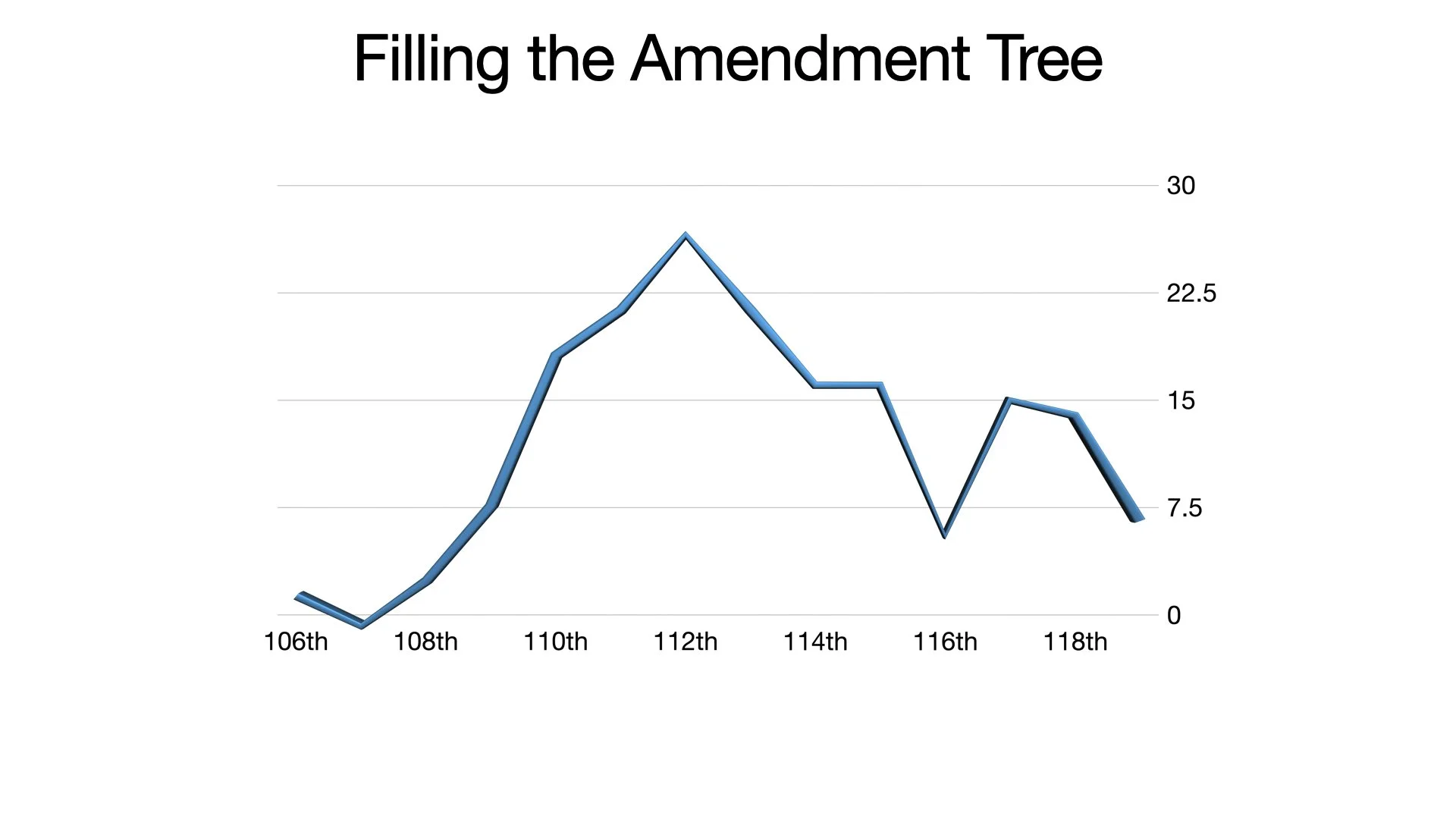
This represents a significant shift in how the amendment tree is used. Originally developed to facilitate an orderly floor process, amendment trees are now often used to block floor amendments altogether. Both parties have relied on this tactic when in the majority. The chart below illustrates the rise of filling the amendment tree.
The majority’s reliance on filling the amendment tree to control floor debate is especially apparent when viewed in the context of floor debate on bills and joint resolutions that have an amendment process.
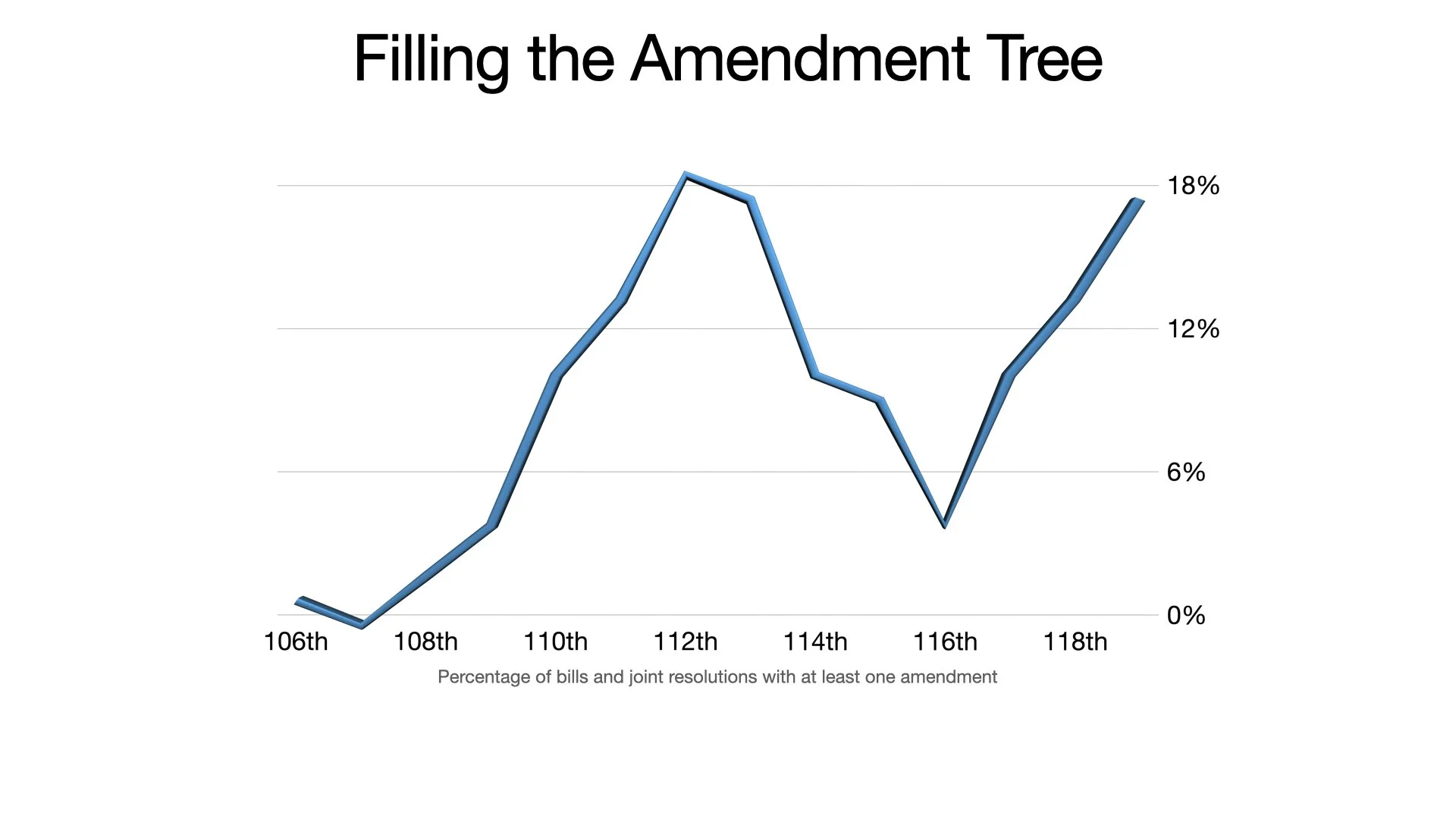
Majority leaders fill the amendment tree for several reasons: to prevent unwanted amendments from receiving votes on the floor, to expedite consideration of the underlying legislation, to strengthen their leverage in negotiations over unanimous consent agreements to structure debate, to ensure legislation receives a vote before it can be amended, and to control the timing and substance of the amendment process.
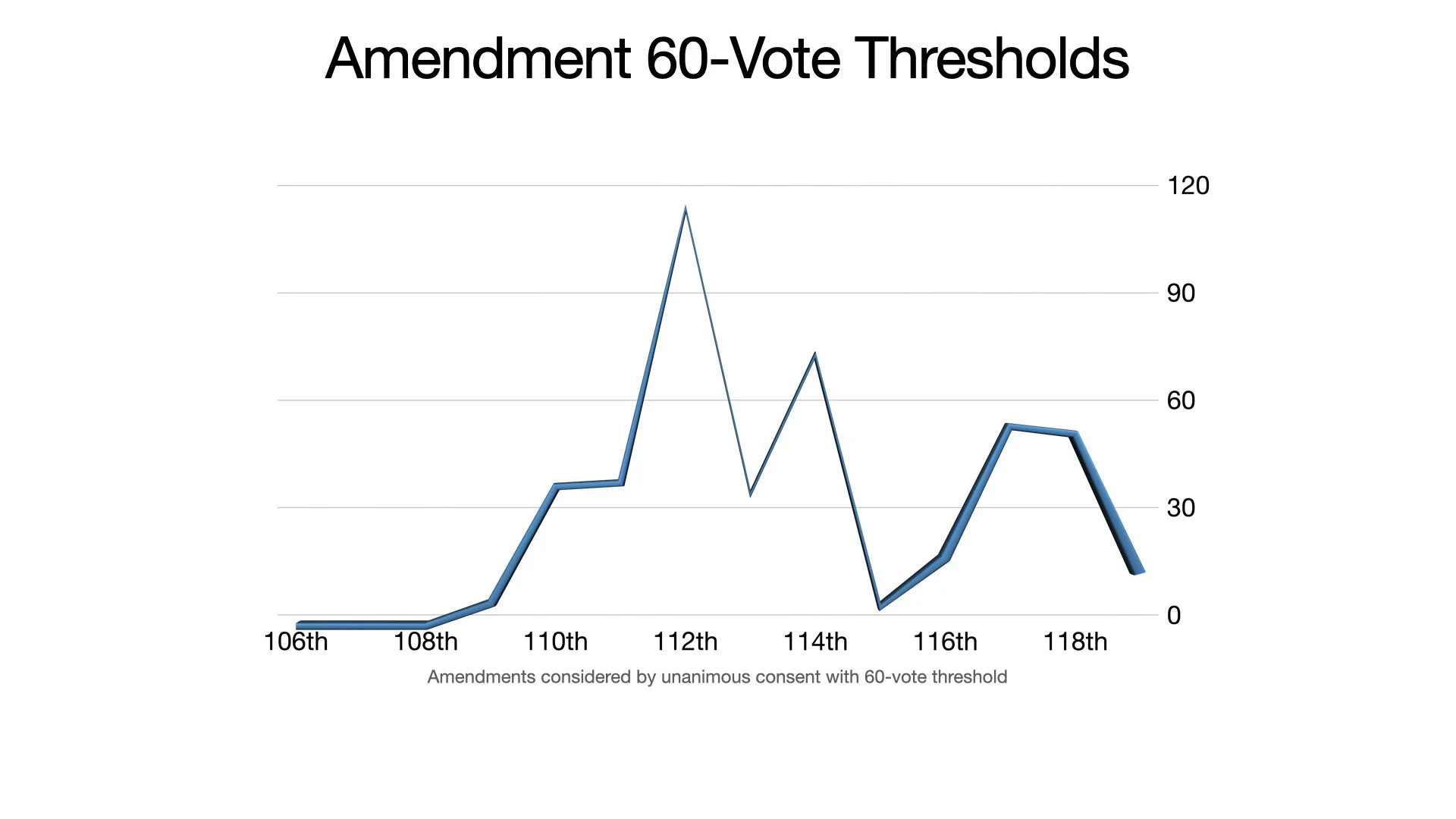
That last point is especially important. The majority often fills the amendment tree to pressure minority-party senators into accepting higher vote thresholds for their amendments in exchange for being allowed to offer them at all. Those thresholds make it less likely that the amendments will be adopted. The earliest documented example of such an agreement occurred in the 102nd Congress. But the practice remained relatively uncommon until the 109th and 110th Congresses, when Majority Leaders Bill Frist, R-Tenn., and Reid began using it more frequently. These unanimous consent agreements typically set a 60-vote threshold for passage. They have become routine in the Senate when considering legislation. The chart below shows the rise in unanimous consent agreements requiring 60 votes to adopt amendments.
This trend becomes even clearer when it is measured as a percentage of all amendments offered in a given two-year Congress.
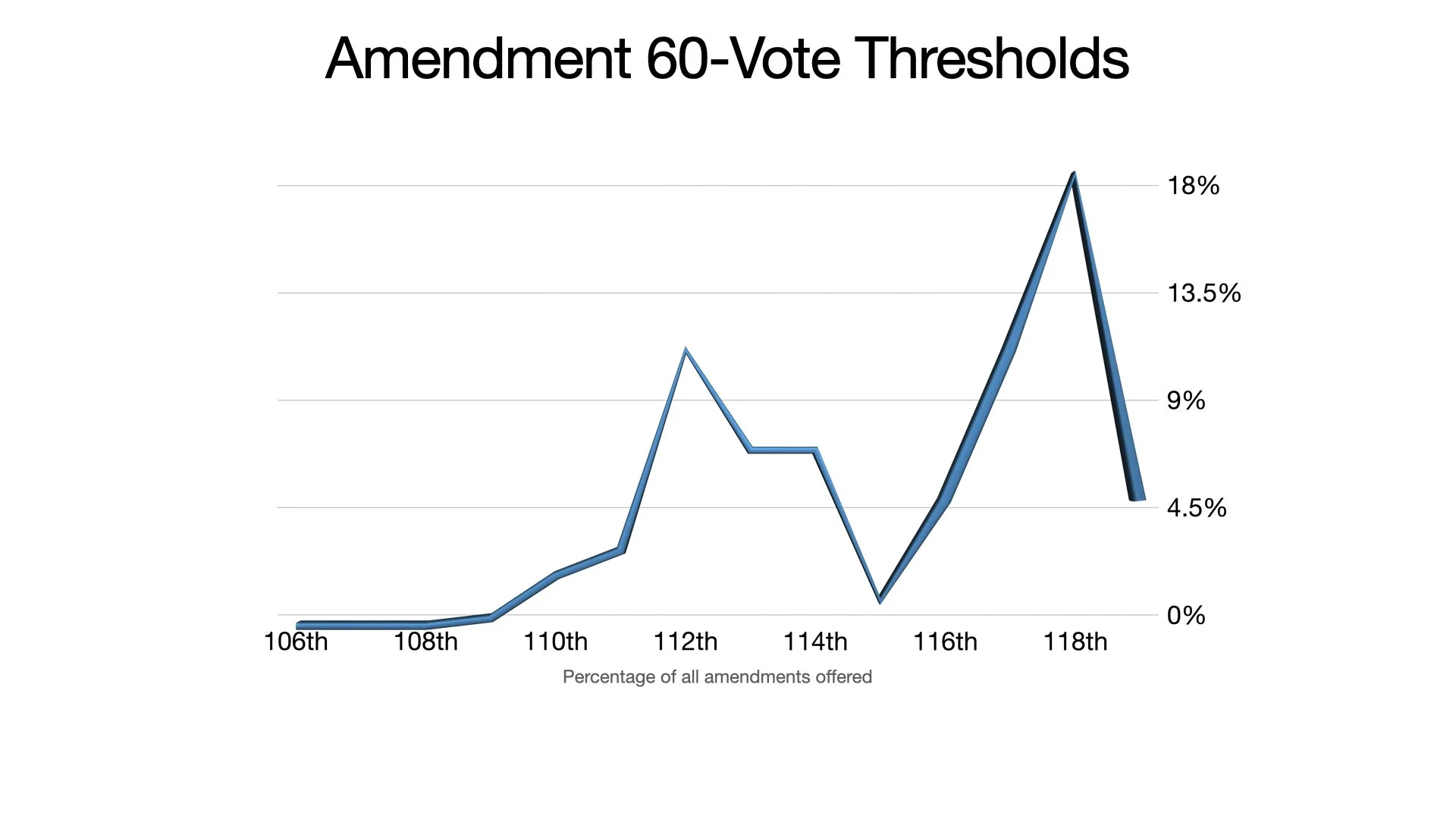
These 60-vote thresholds allow the majority to appear to preserve an open amendment process while minimizing the risk that unwanted amendments will pass. Senators may offer amendments, but the supermajority requirement—meaning approval by at least 60 senators instead of a simple majority of 51—makes adoption unlikely in most cases. When the Senate is in a parliamentary situation requiring unanimous consent to bring an amendment to the floor, the majority leader gains leverage to secure higher vote thresholds for amendment adoption. The majority leader then uses the threat of not allowing amendments to reach the floor to compel senators to agree to those higher thresholds, even though this means the amendment will most likely be rejected.
The dramatic increase in unanimous consent agreements imposing 60-vote thresholds since the 109th Congress underscores the majority’s broader effort to limit the ability of rank-and-file senators in both parties to participate meaningfully in the floor process. When combined with the routine filling of the amendment tree and the cloture process for ending debate, these agreements effectively prevent senators from influencing legislation before final passage. The result is not a deliberative process designed to discern the sense of the Senate, but a floor process that increasingly presents senators with a fait accompli. Such a practice is inconsistent with the principles of general parliamentary law on which the amendment process is based.
Today, the amendment trees are rarely used to structure the orderly consideration of amendments; instead, they are typically invoked only when the majority leader wants to prevent other senators from offering amendments. As a result, the Senate now processes amendments primarily by unanimous consent, rather than by following the precedents that underlie the amendment trees. Senators routinely ask for unanimous consent to set aside pending amendments and call up others out of order. Thus, limiting the majority leader’s ability to fill the amendment tree would not upend the Senate’s existing floor practice; it would simply require the chamber to return to more regular use of amendment procedures that prevailed before the tactic became routine.
The Senate debated legislation for more than two centuries without the contemporary practice of routinely filling the amendment tree solely to block senators from offering their own amendments. Preventing the majority leader from routinely filling the tree may make it harder for the Senate to foreclose amendment votes altogether. But the Senate’s Standing Rules and precedents still provide ample tools to facilitate the orderly consideration of amendments. These include the requirement that committee amendments to reported legislation be considered before floor amendments, precedents prohibiting text that has already been amended from being amended again, Rule XVI’s prohibition on legislating in appropriations bills, and Rule XXII’s filing deadlines and germaneness requirements.
Reform Options
There are two basic ways to address the problem of the majority leader filling the amendment tree to block amendments during floor debate. The first is to limit the majority leader’s priority of recognition. The second is to limit what the majority leader may do once recognized.
The second approach is preferable. The majority leader’s priority of recognition is central to the orderly functioning of the modern Senate. More importantly, senators cannot force the presiding officer to recognize the majority leader, or any other senator, first. Priority of recognition exists because the presiding officer extends that courtesy to the majority leader as a matter of Senate practice. A presiding officer determined to ignore a new rule, or precedent, could still recognize the majority leader, or someone else, first. Senators could challenge that decision and seek to reverse it on appeal, but only after the fact.
A better approach is to leave the majority leader’s priority of recognition intact while limiting its use to fill the amendment tree. Rule XV governs amendments, and Rule XXII already limits the number of amendments senators may offer sequentially after cloture has been invoked. A similar approach could be adopted here. The Senate could provide that once a senator has been recognized to offer an amendment, other senators must have the opportunity to do likewise before that senator may be recognized again to offer another amendment. In practice, “the opportunity to do likewise” would simply mean that no senator may preemptively block others from offering amendments by filling the tree first. If the tree is not full, senators have the opportunity to offer amendments, whether or not they choose to exercise it.
Any ambiguity in such a reform would be resolved, as it often is in the Senate, through specific parliamentary rulings and the precedents that follow. But the basic effect would be straightforward: the majority leader could no longer use repeated recognition to occupy every available branch on the amendment tree before other senators had a chance to participate.
Reform Text
RESOLUTION
To improve the Senate amendment process.
Resolved,
Rule XV of the Standing Rules of the Senate is amended by inserting the following after paragraph 5:
“6. No Senator shall call up more than one amendment until every other Senator shall have had the opportunity to do likewise.”
The Takeaway
Filling the amendment tree was not always a leadership tool for shutting down the floor. It became one because the majority leaders began clamping down on the amendment process by using their recognition priority to occupy every available branch before other senators had a chance to participate. Both parties have embraced the practice because it works — it blocks unwanted amendments, extracts supermajority thresholds from senators who want the chance to offer amendments, and insulates majority-party senators from votes they would rather not cast.
The consequences are straightforward. Senators cannot meaningfully shape legislation on the floor, and minority-party senators have no reason to help bring bills up if getting there just means a closed amendment process. But obstruction at the beginning of the process is, in part, a rational response to exclusion at the end.
The reform here is simple: no senator may call up more than one amendment until every other senator has had the opportunity to do likewise. That is not a structural overhaul. It is a single rule change targeting a single abuse. Whether the Senate chooses to make it is a question of whether the majority of senators are willing to accept a floor process they cannot fully control in exchange for the opportunity to debate their agenda.